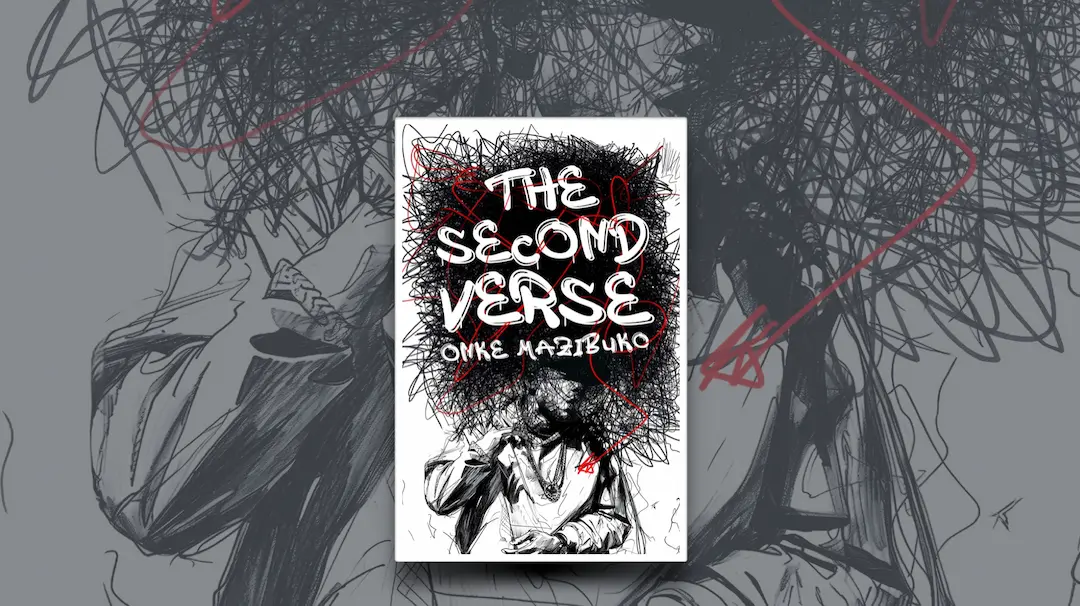
A lyrical story of healing and self-discovery, tracing two intertwined lives as they navigate
love, loss, and the search for meaning across generations.
Bokang’s world is unraveling—his father’s drinking and gambling drag the family into chaos while he struggles to belong at his elite South African school. Too black for the white kids, too white for the black kids, all he wants is to rap, draw, and be left alone.
But his essay on suicide sets off alarms, forcing him to confront problems he can’t escape: family poverty, the shame of missing Xhosa initiation, and a violent, volatile father.
Then comes Nokwanda, beautiful and complicated, with a jealous boyfriend ready to break bones. For Bokang, survival isn’t just about school or family—it’s about finding his flow before everything collapses.
Praise for The Second Verse
“A significant contribution… in creating awareness on mental health issues, The Second Verse rings a siren of caution on how childhood traumas—when unresolved—could cause disruptive behaviors in our adult lives. The themes challenged my perspective on the scale of mental and emotional battles teenagers are dealing with…”
Longlisted: Sunday Times (South Africa) Literary Awards
Winner: Youth Literature Category — South Africa Literary Awards
Mr. Knowles’s suit looks like it’s made from the same material as a seatbelt–cheap, dark-brown and faded–probably as old as he is.
“Bo-gang. Talk to me.”
He looks at me as if I owe him something. After all this time at this school, and still this fool can’t say my name right. No surprise. They all like this.
“Look Bo-gang, I’m here to help you. This is about what’s best for you. I can’t help you if you won’t speak to me.”
Right. The only thing that matters to him is the school’s reputation. He cares about me about as much as a butcher cares about animal rights. His eyes give him away; the stretched skin under one of them twitches. He waits.
Silence is golden and patience is a virtue. Let’s do this thing, then. His office really sucks for a deputy principal’s. It’s not much of an office actually, but then again, he’s not much of a deputy either. I bet the head and the other deputies laugh at his punk—Punk-ass Knowles. That’s what they should call him. His office is all the way at the back of the school, in the dead zone, where nobody ever goes. There’s barely enough space for the two of us in here, with his long legs and all. The walls aren’t even the same colour, and it stinks of boiled cabbage and old newspapers. Ten bucks says this used to be a cupboard or something.
Someone’s stupid laugh comes from outside: loud and care-free. Other boys out there enjoying their break-time, while I’m stuck in here, dealing with this petty nonsense. Mr. Knowles holds up the essay.
“Help me understand this, Bo-gang, please.”
He must think he’s talking to one of his sorry-ass kids when they step out of line. So lame.
“Sir, I don’t know what to say.”
“This essay is, well…what can I say? Shocking, to say the least. Don’t you think?”
“It’s just an essay, Sir.”
“Just an essay? No, Bo-gang. This is…a lot more, I think.”
He can believe what he wants. This fussing is way overboard. I actually thought I did pretty well on this one.
“You’ve written here about suicide, Bo-gang, in great detail. We’re concerned about you.”
Why can’t this damn chair swallow me whole and save me from this grief? Punk-ass Knowles, with his punk-ass questions. Best for me? What the hell does anyone know about what’s best for me?
Mr. Knowles goes on to ask me questions about my school subjects. I tell him. He asks me about my teachers. I tell him that, too. He asks me about English and my teacher, Ms. Hargreaves. I tell him what he already knows. He wipes his hand across his spotted forehead.
“Talk me through this essay. Why suicide?”
“It was the topic, Sir.”
“No. The task for Ms. Hargreaves’ essay was to design a project to address any social issue. You chose suicide. Not as the social issue, but as a solution.”
The man has interesting books on his shelf, the titles running along the spines. One of them is really thick: Diagnostic and Statistical Manual of Mental Disorders. It’s like a bible of the things psychos suffer from, I bet. Probably has mad-parables and verses of the ins-and-outs of insanity, people’s shortcomings and suffering, definitions of oddballs, treatments for the marginalised and normal run-of-the-mill shamefaced losers. But what does it say about the society that created them?
“People should not be stopped when they want to kill themselves,” Mr. Knowles reads from my essay. “They should in fact be encouraged. Every person has the ability to make decisions. This should be respected. Suicide is a person’s prerogative. People should not say it is a wrong act or a cowardly decision. People should not even say it is a brave decision. It is only a decision, made by a person for themselves.”
His eyes trail out the window. He turns back to me with an expression I don’t get.
“What are you really trying to say here?”
“Maybe you should read the whole thing, Sir.”
“I have, and I must say, I am not only appalled, but greatly disturbed.”
Trust Mr. Knowles not to get it.
“I thought shrinks weren’t supposed to be judgemental, Sir.”
Mr. Knowles’s brow drops. He tries a smile, but his clenched jaw undermines any friendliness he might be trying to fake.
“Bo-gang.”
“My name is Bokang, Sir.”
“Bo-kang. Look, as I have said to you already, your well-being is our greatest priority. You must appreciate the fact that you’re part of this exceptional college, and everything that affects you, affects us too. I’m trying my level best to ensure an amicable outcome for everyone concerned.”
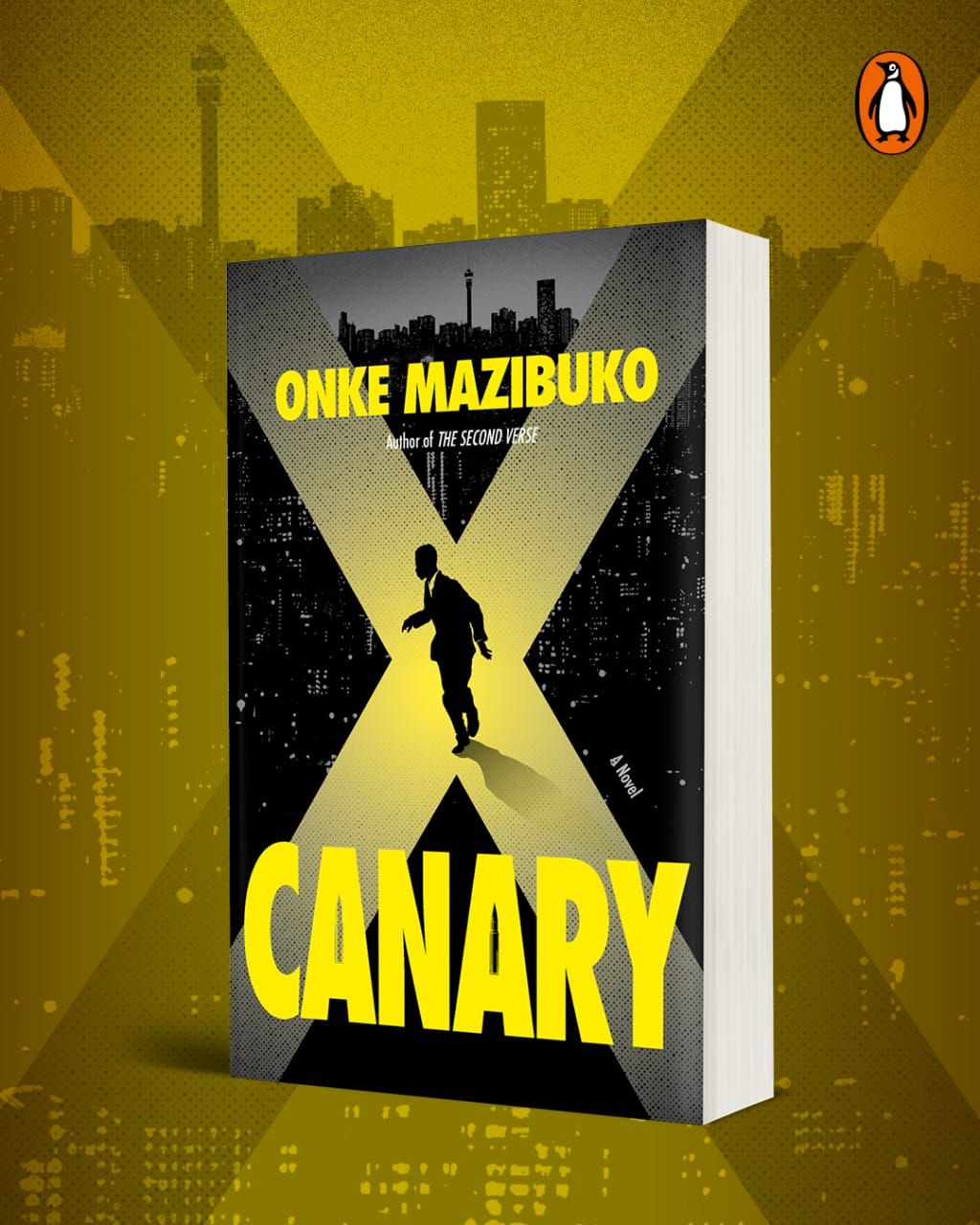
Maks Ntaks has a target on his back. After years of loyal service at Arms-Tech Industries,
he stumbles onto proof of massive corruption—fraudulent tenders, illegal kickbacks, inflated
contracts. Determined to do the right thing, he plans to blow the whistle. But in a company
where the bosses are complicit and coworkers look the other way, he quickly learns that exposing
the truth could cost him everything.
When his longtime mentor frames him in the very crimes he’s trying to reveal, Maks finds himself
cornered on all sides. His employers want him silenced, foreign players are hunting him down,
and his own private secrets threaten to unravel what’s left of his life. In this taut and harrowing
thriller, Onke Mazibuko shows what happens when one good man dares to follow his conscience in a
system designed to destroy him.
Note: Canary is currently only available in South Africa from the following retailers.
The gun pointed at my head is one of ours. A black Beretta 9-mm pistol.
I know this because my job, up until a few months ago, was to procure weapons
on behalf of the South African government...
This story could begin at just about any point in the last eighteen months.
But the moment that makes the most sense is about five months ago. With that performance review.
It was all I could think about in the weeks building up to it. The days creeping closer.
The last night’s sleep before the big day.
Whatever I did, from the moment I climbed out of bed – still tired and short of sleep –
felt like I had a hundred pairs of baleful eyes watching me. I didn’t know whether to brush my teeth first or take a dump.
I stood in front of the mirror, crusted sleep caked around my eyes and dried saliva at the corners of my mouth.
My bowels were solid with concrete.
A run was imperative, despite the grogginess. It was still dark outside; the best time to run.
My neighbourhood was under constant development; new, bigger houses always coming up,
and grander, more expensive complexes sprouting everywhere. Private schools. State-of-the-art hospitals. Malls. Coffee shops.
It was the place to be for people on the move. The streets were wide and even. The hills were moderate.
I blitzed eight kilometres in forty minutes. It was a push. I should have only done five,
but I was trying to outrun the anxiety. A monkey at the circus. A hamster on a wheel. A cog in a machine.
Pavlov’s dog, classically conditioned. Against the wind, I put one foot in front of the other.
Nausea. I fought it like I fought the fatigue. I couldn’t stop. Couldn’t allow it to get me.
Couldn’t give up. Not now. Not ever. The pain in my muscles was ecstasy. The burn gave me hope.
My reward was a good, relieving shit.
I took a cold shower afterwards. I thought of times in my life when I had little to no luxuries.
When I still had the hunger of a person striving. Hustling. Persevering. Wanting.
I needed that fighting spirit. The cold water and pain through my muscles helped bring focus.
The nausea, though, persisted.
Nevertheless, I smiled as I put on my navy suit, the one from Top Man.
I had bought it many years ago when the store was still in Sandton,
before the entire brand left the country for good. A plain white shirt – Ben Sherman.
Yellow tie – Armani. Brown shoes – Kingsley Heath. Natty. My power suit.
I usually didn’t eat a big breakfast, unless I had something important to do that day.
My mother always taught me to face my troubles on a full stomach. And considering what I had to face,
a farmhouse breakfast was what I needed now, but my stomach was not up for it.
The queasiness stayed with me even as I sat behind the wheel of the Mustang still parked in my garage.
If anything could give me confidence, it was this vehicle. Masha was yellow with two thick black stripes
running over the length of her body; she was a beauty.
My daily affirmation helped bolster belief:
I possess the focus and clarity needed to navigate any situation.
Challenges are temporary; my resolve and spirit are eternal.
I am fully aligned with my goals and manifest them into reality with each step I take.
The nausea was still there, though, even after my third recitation, my palms clammy against the steering wheel.
‘We can do this,’ I said.
Masha the Mustang didn’t respond – not in words. She did provide comfort, though, as she always did,
her engine purring as she carried me through the early morning to the office.
Even though it wasn’t far, I still liked to get there early, before anyone else.
It was the third Wednesday of March. Right before the Human Rights Day long weekend.
Technically it wasn’t supposed to be a long weekend, but most people had planned to take the Friday off to make it one.
The day promised good, sunny weather. No wind. Few clouds. Just dry highveld air. Nosebleed stuff.
I greeted the security guards with a smile and a joke about the local premier league soccer midweek fixtures –
something I didn’t really care about but followed for the sake of office banter.
I bought the daily paper from the vendor downstairs and holed up in my office with a large cup of tea –
two tea bags of vanilla chai from Woolies and three teaspoons of honey. Everybody needs their fix; this was mine.
A story on page two made me spill a little of the chai:
Whistleblower murdered outside her home